
遞迴是什麼?遞迴是什麼?遞迴是什麼?(真的要無限嗎OAO?)

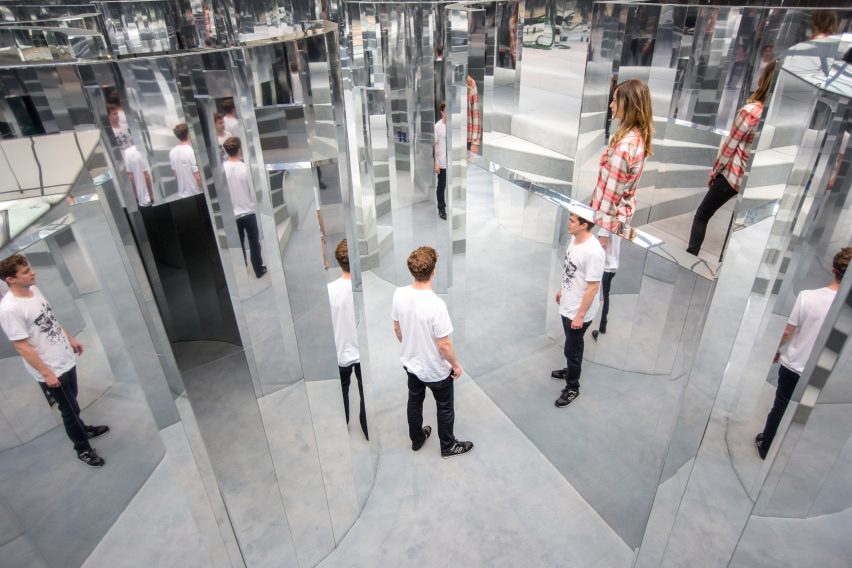
鏡子! 就像無數遞迴一樣
你照鏡子時會看到自己,對吧?(廢話
如果你站在鏡子前,背後又同時有鏡子呢?
畫面就會不斷反射,形成無限循環!
這個概念,正是遞迴的核心思想。
基本概念
當一個函數在執行時呼叫自己,就是遞迴。
以下為以C++作為示範。
void recursion(int& n){
  if(n == 0) return;
  // ↑ Base Case: 若n==0,終止遞迴

  // ↓ Recursive Case:遞迴要執行的邏輯
  // 這裡可以是一些操作或計算

  recursion(n - 1);
  // ↑ 在函式裡呼叫自己,n-1 為減少需處理的n
}
Recursion base concept in C++
核心概念:
- Base Case (基底條件):當滿足某個條件時,就停止呼叫自己,避免無限迴圈。
- Recursive Case (遞迴邏輯):在每一次呼叫中,將規模縮小或轉換,並再次呼叫同一個函式。
實際應用:計算階乘
還記得這個公式嗎?
\[ \begin{aligned} 5! &= 5 \times 4 \times 3 \times 2 \times 1 \end{aligned} \]
這在中學的時候學的階乘!讓我們在C++實現。
int factorial(int n) {
    if (n <= 1) {
        return 1; // Base Case:1! 或 0! 都視為 1
    }
    return n * factorial(n - 1); // Recursive Case:n * (n-1)!
}
為何 \(N\le1\)就要返回\(1\)?
首先,這是Base Case,這樣可以確保抵達某個數值時結束運算並返回結果。
其次就是在階乘裡\(0!\ = 1\div1\)
階乘的公式為 \( (n-1)! = \frac{n!}{n} \) 或 \( n! = \frac{(n+1)!}{n+1} \)
\[ \begin{aligned} n! &= 1 \\ (1-1)! &= \frac{1!}{1} \\ 0! &= \frac{1}{1} \end{aligned} \]
由此得出\(n\le1\)是需要返回\(0\)。
為什麼用遞迴?
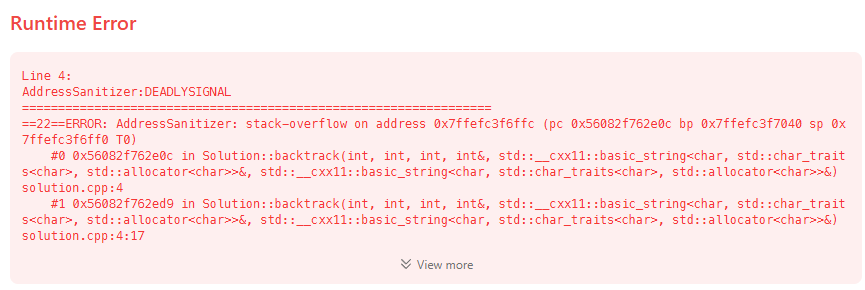
- 程式碼簡潔:幾行程式就能重複執行同一段邏輯。
- 思維符合數學定義:許多數學公式本身就是遞迴(或歸納法)。
- 容易理解問題拆解:遞迴能將大問題不斷拆成小問題。
遞迴vs.迴圈
| 遞迴 (Recursion) | 迴圈 (Loop) | |
|---|---|---|
| 優點 | 更直觀地解決遞推問題,程式碼簡潔 | 佔用較少記憶體,效率較高 |
| 缺點 | 可能導致 Stack Overflow,函數呼叫開銷大 | 需要手動維護變數與狀態 |
| 適用場景 | 樹結構遍歷 (DFS)、分治法 (Merge Sort) | 簡單的重複運算,如加總、迭代 |
總結
在這篇文章,以C++說明了遞迴的基礎知識。若你對編程知識有興趣,不坊定期回來查看我的新文章。你亦可以在右上角註冊會員以接收訂閱的。
What is Recursion? What is Recursion? (Do we really need infinity? OAO)
Mirror! Just like infinite recursion!
When you look at yourself in a mirror, you can see yourself, right?
But what if you stand in front of a mirror, and there's another mirror behind you?
The mirrors will keep reflecting, creating an infinite loop of images!
This concept is a core idea of recursion.
Basic Concept
When a function calls itself during execution, it is called recursion.
Below is an example written in C++:
void recursion(int& n){
  if(n == 0) return;
  // ↑ Base Case: When n == 0, the recursion stops.

  // ↓ Recursive Case:The logic that needs to be executed in recursion.
  // This can include some operations or calculations.

  recursion(n - 1);
  // ↑ Calls itself inside the function, reducing n by 1.
}
Recursion base concept in C++
Core Concepts:
- Base Case: When a certain condition is met, the function stops calling itself to avoid an infinite loop.
- Recursive Case: In each function call, the scale is reduced or transformed, and the same function is called again.
Practical Application: Calculating Factorial
Do you remember this formula?
\[ \begin{aligned} 5! &= 5 \times 4 \times 3 \times 2 \times 1 \end{aligned} \]
This is the factorial you learned in middle school! Let's implement it in C++.
int factorial(int n) {
    if (n <= 1) {
        return 1; // Base Case: 1! and 0! are both defined as 1
    }
    return n * factorial(n - 1); // Recursive Case:n * (n-1)!
}
Why return \(1\) when \(N\le1\)?
First, this is the Base Case, which ensures that the recursion stops when a certain value is reached and returns the result.
Next, this is based on the definition of factorial: \(0!\ = 1\div1\)
The factorial formula is: \( (n-1)! = \frac{n!}{n} \) or \( n! = \frac{(n+1)!}{n+1} \)
\[ \begin{aligned} n! &= 1 \\ (1-1)! &= \frac{1!}{1} \\ 0! &= \frac{1}{1} \end{aligned} \]
Thus, we conclude that when\(n\le1\), we must return\(0\)。
Why Use Recursion?
- Simplifies Code: A few lines of code can repeatedly execute the same logic.
- Matches Mathematical Definitions: Many mathematical formulas are naturally recursive (or defined by recurrence relations).
- Helps with Problem Decomposition: Recursion can break down large problems into smaller subproblems.
Recursion versus Loop
| Recursion | Loop | |
|---|---|---|
| Advantages | More intuitive for solving problems related to iteration, simpler code. | Uses less memory and is more efficient. |
| Disadvantages | Can lead to Stack Overflow if the function call depth is too large. | Requires manually maintaining variables and states. |
| Best Use Cases | Tree traversal (DFS), divide and conquer (Merge Sort). | Best for simple repetitive operations, such as summation and iteration. |
Summary
In this article, I explained the basics of recursion using C++. If you're interested in programming concepts, feel free to check back for new posts! You can also subscribe in the top-right corner to receive updates.